
Insights • Vendor Selection
Choosing a Software Development Services Company: A New Model for Predictable Outcomes
Tired of missed deadlines? Learn how to choose a software development services company with a new model for predictable outcomes and enterprise-grade quality.
Another missed deadline. Another round of buggy code. If you have been burned by outsourcing partners who deliver more headaches than results, you understand the stakes. The traditional models for engaging external teams are fundamentally flawed, leaving you with high management overhead and outcomes that are anything but predictable. Meanwhile, the internal pressure to ship faster and innovate mounts, but hiring the senior-level talent required to accelerate your roadmap is a constant battle.
Choosing the right software development services company is about more than just finding developers. It is about finding a partnership model that guarantees velocity and enterprise-grade quality. This article moves beyond outdated approaches to vendor selection. We deconstruct the common service models and expose their inherent weaknesses. More importantly, you will discover why dedicated senior engineering pods are a superior model for achieving predictable project outcomes, accelerating your time-to-market, and scaling your engineering capacity with a team that takes ownership of your results.
The Landscape of Software Development Services: Understanding Your Options
A modern software development services company provides the engineering talent and operational framework to design, build, and scale digital products. Businesses engage these partners to accelerate roadmaps, access specialized skills, and achieve specific technical outcomes without the overhead of direct hiring. However, the success of this partnership depends entirely on the engagement model. Choosing the right structure dictates control, accountability, and ultimately, the results.
Model 1: The Project-Based (Fixed-Price) Approach
- Pros: Costs and delivery schedules are defined upfront, minimizing financial risk.
- Cons: High rigidity makes it unsuitable for agile environments. Any scope change requires renegotiation, and quality can be compromised to protect fixed margins.
Model 2: The Time & Materials (T&M) Approach
- Pros: Highly adaptable to shifting priorities and market feedback.
- Cons: Budgetary risk is high without rigorous client-side oversight. The client bears the full responsibility for project management.
Model 3: The Staff Augmentation Approach
- Pros: Rapid access to talent and complete control over the developer's day-to-day tasks.
- Cons: Creates significant management overhead, risks cultural mismatch, and offers zero accountability for project outcomes.
The Flaws of Traditional Models: Why So Many Projects Underdeliver
Traditional staff augmentation promises agility and cost control. Yet engineering leaders are often left with a familiar outcome: missed deadlines, budget overruns, and a final product that falls short of enterprise-grade standards. The problem is not a lack of developers; it is a fundamental misalignment of incentives. The model rewards task completion, not successful outcomes, creating a deep-seated disconnect between the vendor and the client's business goals.
The Ownership Gap: Task-Doers vs. Problem-Solvers
Staff augmentation delivers "hands on keyboards" — not strategic partners invested in your success. This creates a reactive development cycle where your internal leaders bear the full weight of architectural decisions, quality assurance, and roadmap execution. The vendor's job is done when hours are billed.
The Quality vs. Cost Trade-off
To compete on price, a traditional software development services company often builds teams with a high ratio of junior-to-senior talent. The long-term cost is severe. Inexperienced developers introduce technical debt, leading to brittle codebases, poor performance, and a development velocity that grinds to a halt as complexity grows.
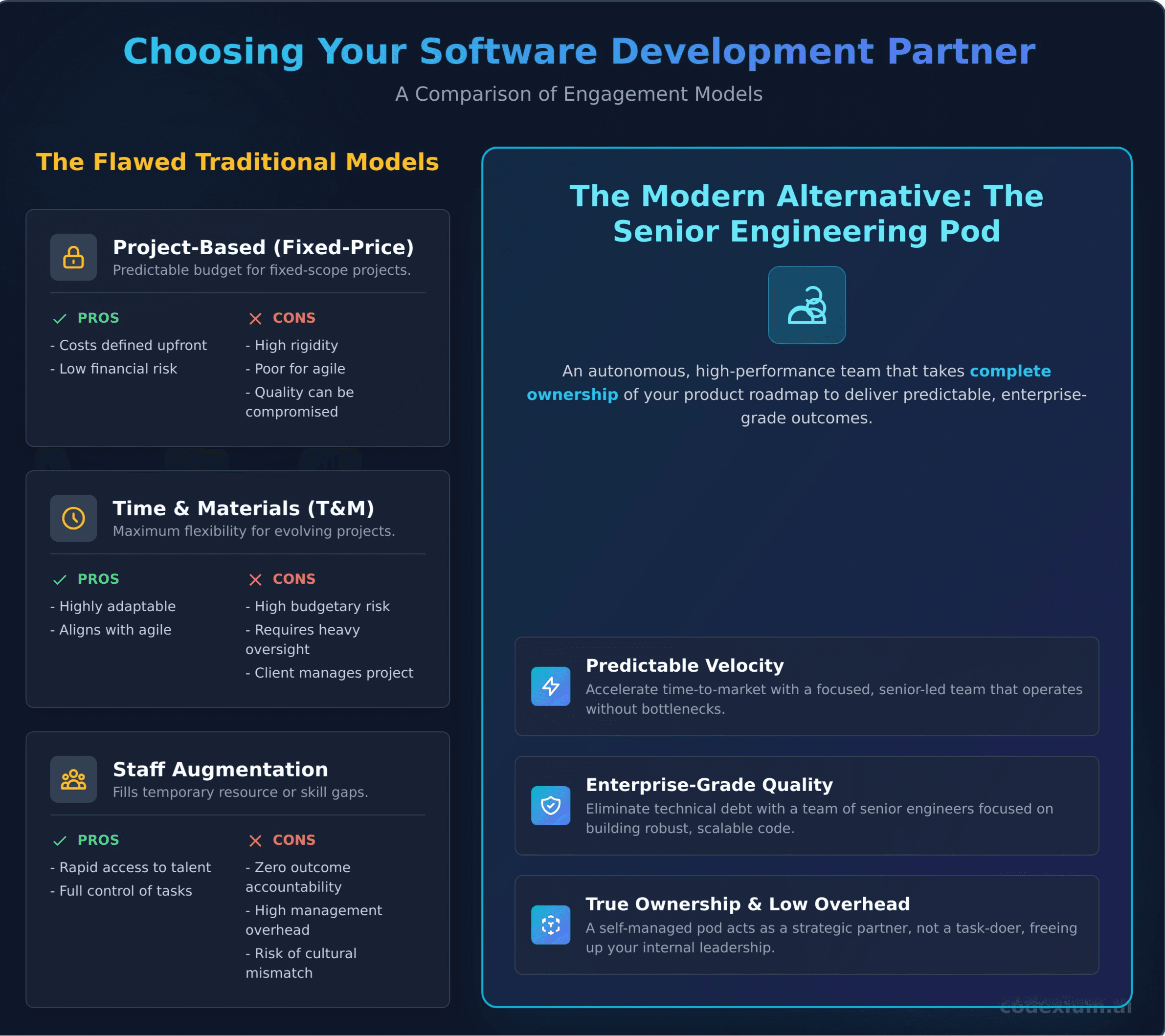
Model comparison snapshot
The Communication Bottleneck
The hidden tax on traditional outsourcing is management overhead. The constant cycle of status meetings, clarifications, and course corrections across different time zones and cultural contexts drains your team's most valuable resource: focus.
- Delayed decisions from limited access to senior engineers.
- Misaligned context that meets the ticket but misses the intent.
- Excessive oversight that steals time from your best engineers.
A Modern Alternative: The Senior Engineering Pod Model
Traditional staff augmentation fills seats. The Engineering Pod model delivers outcomes. This approach moves beyond providing temporary headcount to deploying a fully autonomous, high-performance team engineered to take complete ownership of your product roadmap. It is a fundamental shift from renting developers to integrating a strategic partner focused on building, shipping, and iterating with enterprise-grade quality.
What is an Engineering Pod?
A Codexium Engineering Pod is a small, cohesive unit designed for maximum impact and minimal overhead. Unlike disconnected freelancers or individual contractors, a pod operates as a single, self-managed entity:
- Structure: 2–5 senior engineers and a dedicated team lead.
- Responsibility: Full ownership of a feature, product vertical, or technical challenge.
- Collaboration: Nearshore teams for timezone alignment and fast decision loops.
The Senior Engineers Only Philosophy
Our pods are staffed exclusively with senior talent. This is not an arbitrary standard; it is a core tenet that drives efficiency and quality. Senior engineers produce higher-quality code, architect more resilient systems, and solve complex problems faster. This philosophy eliminates the need for client-side hand-holding and management.
Accelerated by Practical AI
Human expertise is amplified by intelligent automation. Every Codexium pod is equipped with a suite of AI assistants and proprietary automation tools that accelerate the development lifecycle. This practical application of AI boosts efficiency by handling repetitive tasks like code generation, test creation, and dependency analysis. For deeper delivery context, see AI-Powered Delivery.
Model Comparison: Engineering Pods vs. Traditional Services
Ownership
Traditional staff augmentation focuses on tasks. Engineering pods own business outcomes end-to-end.
Management Overhead
Pods are self-managed and autonomous, reducing the need for constant client supervision.
Speed
Pods provide predictable velocity from day one with senior-only teams.
Quality
Enterprise-grade delivery is enforced through senior engineers and AI tooling.
How to Choose the Right Software Development Partner
Selecting the right partner is about securing predictable outcomes. Use this framework to evaluate potential partners and ensure you choose a team structured for delivery.
- Team Composition: Ask about the exact seniority level and whether they are full-time engineers.
- Accountability: Require ownership of outcomes, not just hours billed.
- Integration: Ensure they can integrate with your workflow and tools.
- Efficiency: Verify the use of automation, QA, and modern tooling.
Service Links for Evaluation
As you compare partners, explore service areas that map to predictable delivery:
- Full-Stack Development for end-to-end product execution.
- AI Engineering for production-grade AI delivery.
- Cloud & DevOps for reliability, CI/CD, and observability.
- QA Automation for consistent quality gates and regression coverage.
Choose Predictability, Not Just a Partner
The path to successful software delivery is no longer a matter of chance. Traditional models often result in missed deadlines and compromised quality. The modern alternative — the Senior Engineering Pod model — provides a clear framework for achieving predictable velocity and enterprise-grade results. When selecting a software development services company, the critical shift is from hiring for tasks to partnering for outcomes.